_w=1366_h=910_pjpg.jpg?v=202405071552)
Why Visit Corfu?

Corfu sits between the Adriatic and Ionian seas, and its position has shaped the island over centuries. Successive periods of Venetian, French and British rule have left a clear imprint, creating a character that feels distinct from other Greek islands. Venetian influence is the most visible, but elements of French design and British planning remain part of daily life, sitting naturally alongside long-held Greek traditions.
This mix is most clearly seen in Corfu Town. The UNESCO-listed Old Quarter is compact and walkable, with narrow streets running between pastel façades and opening onto arcaded walkways, small squares and local cafés. The Liston promenade, built during the French period continues to be a social focal point, particularly in the early evening. Nearby, the Spianada - the largest square in Greece - reflects the island’s British chapter, complete with open lawns and even a cricket pitch.
As our villa specialist Daphne says, "Corfu is steeped in history with the main town considered one of the most beautiful towns in Greece, offering a fusion of Venetian, French and British cultural heritage, where I'd recommend you stop at a rooftop bar and enjoy a cocktail with a panoramic view."
Away from Corfu's capital, the landscape becomes noticeably greener than on many Greek islands. Olive groves planted centuries ago cover the hills, cypress trees mark village skylines, and the interior is dotted with stone settlements such as Old Perithia, where much of the original architecture remains intact. On the southwest coast, Lake Korission forms a protected wetland, bordered by sand dunes and known for its birdlife.
The northeast coast draws many visitors for its calmer waters and small, well-established villages. Places such as Kalamaki, Agni, Kerasia, St Stephano and Kassiopi are built around harbours and pebble coves, with easy access to the water. Days here tend to follow a simple pattern: swimming in the morning, short boat trips along the coast, and long lunches at waterside tavernas before returning in the softer light of late afternoon.
Corfu has even hit the big screen recently, including through the BBC series Amanda and Alan’s Greek Job, which followed the restoration of a historic Corfiot property and highlighted the island’s architectural heritage.
To explore Corfu in more detail, including the best time to visit, getting to Corfu, cultural highlights, beaches, food, cultural and places to stay, explore our Guide to Corfu and plan an island stay that suits you.
Best Time to Visit Corfu
Corfu is very much a year‑round island, but when you visit makes a noticeable difference to how it feels. The best time to go depends less on a single 'perfect' month and more on whether you’re drawn to long beach days, outdoor exploring, or seeing the island at a quieter, more local pace.
From late spring to early autumn, Corfu is at its most accessible and lively. According to Responsible Travel, the main season runs from May through October, when temperatures are warm, services are fully open and the sea is inviting for swimming.
Late spring (May and June) is a favourite for many travellers. The island is at its greenest, wildflowers fill the countryside, and daytime temperatures are warm without being overwhelming. It’s ideal for walking, sightseeing and boat trips, with the added advantage of quieter beaches and easier reservations at tavernas. The sea begins to warm from late May, making swimming increasingly appealing as June approaches.
High summer (July and August) delivers classic Mediterranean conditions: long, hot days, warm nights and sea temperatures at their most comfortable. This is the best time for swimming, watersports and lazy beach days, but it is also the busiest period. Lonely Planet notes that July and August are the island’s hottest and most crowded months, particularly during European school holidays, when popular beaches and Corfu Town can feel lively from morning to night.
For many, early autumn (September and October) offers the best balance. The sea retains its summer warmth, the heat softens, and the island noticeably calms. Restaurants and beach facilities remain open, but there’s more space to explore at your own pace. Responsible Travel highlights September and October as excellent months for walking and outdoor activities, as well as swimming without peak‑season pressure.
Getting to Corfu

Despite its island setting, Corfu is among Greece’s most accessible destinations, making it an easy choice for both short breaks and longer villa holidays. Corfu International Airport, also known as Ioannis Kapodistrias Airport, receives direct flights from the UK and many European cities, particularly from spring through autumn, keeping travel straightforward and efficient. During peak season, frequent services operate from several regional airports, while outside these months Corfu remains easy to reach via Athens with regular onward flights.
Corfu is also well connected by sea. Regular ferries link the island with mainland Greece via Igoumenitsa and Patras, as well as neighbouring Ionian islands, making it well suited to island‑hopping or multi‑stop itineraries. The short distance to the Albanian coast adds another dimension, allowing for easy cross‑border day trips or combined journeys for those keen to explore further. Arriving by ferry can be especially memorable, with Corfu Town’s historic fortresses and harbour gradually coming into view from the water.
Once on the island, transport choices shape how Corfu is experienced. While public buses provide reliable connections between Corfu Town, major resorts and popular beaches, many visitors prefer the flexibility of independent travel, particularly when staying in a villa. Road journeys tend to be scenic rather than rushed, winding through olive groves, hillside villages and along dramatic stretches of coastline that reward unhurried exploration.
Car Hire
A car hire offers freedom to explore inland villages and mountain roads, as well as west coast beaches and quieter corners of the island that are harder to reach by public transport. For inland drives or a seamless arrival, we can arrange car hire and transfers before you travel. This ensures your holiday begins the moment you land, with everything tailored to your itinerary.
Boat Hire
The northeast coast is particularly well suited to small‑boat days, thanks to its sheltered waters, short distances between coves and clear visibility. Exploring Corfu by boat reveals hidden bays and swimming spots inaccessible by land. If you’re interested in arranging boat hire, contact one of our villa specialists.
Culture & History in Corfu

Corfu has attracted countless suitors over the centuries. Ancient Greeks, Romans, Normans, Venetians, the armies of Napoleon and the British Empire all laid claim to the island, each leaving behind traces that quietly shape life here today.
Nowhere captures this layered identity better than Corfu Town’s UNESCO‑listed Old Town. Wander its cobbled backstreets and you’ll find washing strung between warm, tan‑coloured houses, shuttered windows and tucked‑away squares where daily life unfolds at an unhurried pace. With its arcaded walkways and elegant facades, it’s easy to mistake parts of the town for a southern Italian village, a legacy of centuries of Venetian rule that shaped everything from fortifications to civic life.
The town’s fortified character remains visible in the Old and New Fortresses that frame the city, guarding a capital that was never occupied by the Ottomans, unlike many of its neighbouring Greek islands, and therefore retains much of its historic urban fabric. Closer to the Old Fortress, French influence emerges along the Liston, a 19th‑century arcade inspired by Paris’s Rue de Rivoli. Nearby, the Palace of St Michael and St George recalls a later British chapter, now housing art collections and formal gardens.
Beyond the capital, Corfu’s cultural mosaic continues. The Achilleion Palace rises above the east coast, a romantic 19th‑century retreat commissioned by Empress Elisabeth of Austria as a personal homage to classical Greece. Set within landscaped terraces and overlooking the Ionian Sea, the palace blends neoclassical architecture with dramatic sculptures of Achilles, a reflection of Elisabeth’s fascination with Greek mythology.
Corfiot Beaches Worth Your Time
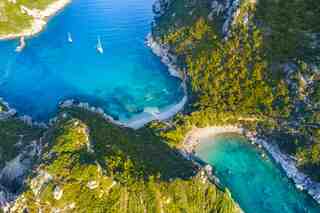
Corfu has beaches for every mood, but the north‑east coast stands out for its sheltered shores, gentle seas and close‑set coves, perfect for easy boat days and lingering lunches at jetty‑side tavernas. As our Product Manager Katherine says, “Make the most of the crystal‑clear turquoise waters - they’re ideal for boating and snorkelling.”
Kalamaki is the north‑east’s family‑friendly outlier: a sandy beach that shelves gradually, with loungers, a long jetty for boat arrivals, and low‑key tavernas for long lunches. Access is easy by car or boat, which keeps logistics simple for mixed‑age groups.
For classic pebble‑and‑turquoise scenery, Avlaki delivers crystal‑clear water and straight‑off‑the‑beach swimming; it stays peaceful even in high season and has two excellent tavernas behind the shore.
Ten minutes south of Kassiopi, Kerasia feels perfectly secluded: a shingle strand flanked by trees, a single quality taverna, showers and sunbeds, and water that’s tailor‑made for long swims.
Pocket‑sized Kaminaki and Agni epitomise the north‑east: white pebbles, clear water, a handful of tavernas and jetties that make arriving by small boat a pleasure.
Kalami pairs calm seas with a literary backstory - British writer Lawrence Durrell lived in the 1930, writing from a house overlooking the bay - with a selection of waterside places to eat.
Further south, Nissaki offers a pretty shingle cove with transparent water and a small dive scene; it’s a gentle first snorkel with classic on‑the‑water tavernas. If you want more buzz without losing clarity, Barbati brings a longer pebble ribbon, watersports, sun‑loungers and a grown‑up beach bar vibe that gets lively in peak season.
Food & Drink in Corfu

Corfu’s cuisine is one of Greece’s most distinctive, shaped by centuries of Venetian rule and enriched by the island’s fertile landscape and abundant seas. While familiar Greek staples appear on menus, Corfiot food stands apart for its slow‑cooked dishes, generous use of spices, and Italian‑influenced techniques that are rarely found elsewhere in the country.
At the heart of Corfiot cooking are three iconic dishes that reveal the island’s culinary lineage:
- Pastitsada is perhaps the most emblematic: traditionally served on Sundays and festive occasions, it features rooster or beef slow‑braised in a rich tomato sauce infused with cinnamon, cloves and local spice blends, then served over thick pasta. Each family and taverna guards its own version, but the result is always deeply aromatic and celebratory in feel.
- Equally rooted in Venetian influence is Sofrito, a lighter but no less characterful dish of veal cooked gently in white wine, garlic and parsley. Silky rather than heavy, it’s typically paired with potatoes or rice to soak up the sauce. Seafood lovers should seek out Bourdeto, a fiery fisherman’s stew traditionally made with scorpion fish and red pepper.
- The island is also famous for noumboulo, a smoked pork loin cured with wine and spices and sliced thin as a meze, especially around Christmas.
- Sweet traditions are just as distinctive. Mandolato, a soft almond nougat, and sikomaida, a dense fig and nut sweet spiced with anise and pepper, reflect centuries‑old recipes.
- Then there’s the island’s most recognisable flavour: kumquat. Introduced during British rule, it’s now synonymous with Corfu, appearing as liqueur, candied peel and spoon sweets served at the end of meals.
Where to eat matters as much as what you order. Along the north‑east coast, tavernas in villages such as Agni, Kalami, St Stephano and Kassiopi serve unfussy, home‑style cooking with jetty‑side tables and views across tranquil bays. Corfu Town broadens the palate with everything from traditional kitchens in the Old Town to more contemporary dining rooms, perfect for lingering evenings under the arches of the Liston.
Where to Stay: Our Villas in Corfu

Our Corfu villa portfolio is thoughtfully placed across the northeast, close to calm coves, small harbours and boat jetties, so the best of the island folds naturally into each day.
Here are a few suggestions to inspire your search:
- Kalokairi Beach House - Set within easy walking distance of sandy Kalamaki Beach, Kalokairi Beach House is a superb coastal property for a group of friends or a family gathering.
- Gallini - In a wonderful waterside setting, with a pool that feels like the prow of a ship, and rock bathing to the left, this is an unpretentious family villa in Corfu, an easy walk from a choice of beaches.
- Mimosa House - Nestled amid silvered olive groves on a peaceful coastal hillside, this excellent luxury villa boasts sea views from the exceptional swimming pool, all in a quiet setting.
To find out more about Corfu, make sure to speak with one of our Villa Specialists or make an enquiry today.
 Chat on Whatsapp